
Å, Ä and Ö
These three letters appear at the end of the Swedish alphabet and are distinct characters.
svenska
Swedish documents are relevant to education, employment, business and cross-border family matters.
Swedish is spoken by approximately ten million people, mainly in Sweden and parts of Finland.
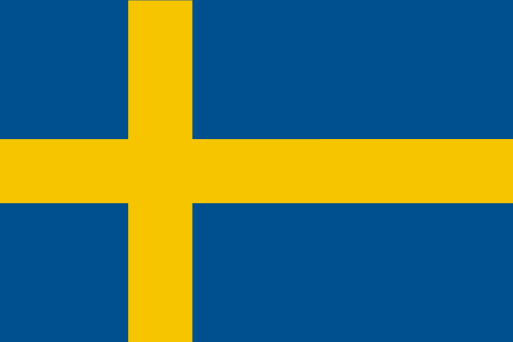 Sweden
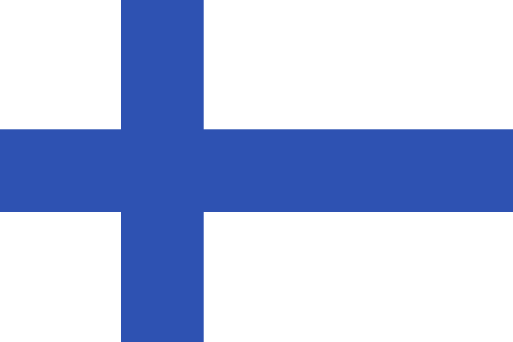 Finland
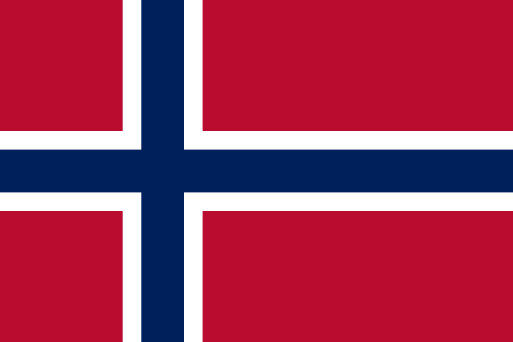 Norway
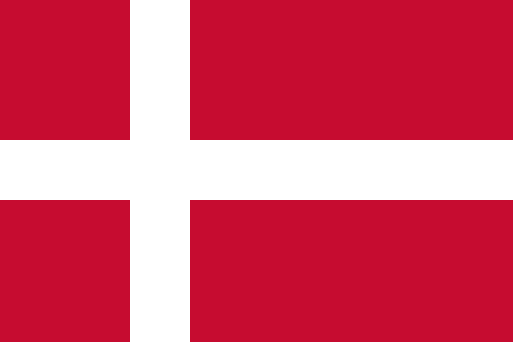 Denmark
Schematic selection of key areas where the language is used. Language use does not always follow national borders; the map is not a comprehensive population statistic.
The language alone is not decisive. ABBA-Sprachendienste also considers the document type, recipient, subject area, certification requirements and requested language direction.
Request a document reviewSwedish belongs to the North Germanic languages and developed from Old Norse. The Bible translation produced under Gustav Vasa in the 16th century is regarded as an important early stage of standardisation.
A spelling reform in 1906 brought many forms closer to their pronunciation. In Finland, Swedish has official status alongside Finnish and has its own administrative traditions.
These three letters appear at the end of the Swedish alphabet and are distinct characters.
Official and place names used in Finland Swedish may differ from those used in Sweden.
The definite article is often added as a suffix; compound specialist terms must be broken down carefully.
The transliteration is intended only as an initial guide. Pronunciation and regional forms may vary.
| Original | Transliteration | Meaning |
|---|---|---|
| God dag | — | Good day |
| Tack | — | Thank you |
| Var snäll | — | Please |
Speaker numbers are rounded estimates and may vary depending on the definition, survey year and whether second-language speakers are included.
Wikipedia · language-specific overview
Library of Congress / ISO 639-2 Registration Authority · Language codes and standardised language names
Unicode Common Locale Data Repository · Language, script and territory names and variants
Max Planck Institute for Evolutionary Anthropology · Language families, classification and linguistic literature
Editorial sources current as at 14 July 2026. The information will undergo a specialist review before the production launch.
Swedish FAQ
Both directions can be requested. Binding confirmation is provided after the document type, subject area, certification requirements, appointment and intended use have been assessed.
Employment and business contracts, diplomas and certificates, civil-status certificates, and technical and medical specialist texts are typical examples. Other types of document can also be assessed using a clear photograph or PDF.
The review covers the language direction, document type, use of the Latin alphabet, names, stamps, subject area, intended use and any potential need for certification.
The receiving authority, court, notary or other requesting body decides this. Tell ABBA-Sprachendienste where the document will be submitted so that the requirements can be assessed appropriately.
Yes. A complete, sharp and clearly legible photo or PDF is usually sufficient for an initial quotation review. Depending on the assignment, the original may also be required later.
Send a clear photo or PDF. ABBA-Sprachendienste will personally assess the language direction, document, intended use and certification requirements.
