
A distinctive alphabetic system
Hangeul may look like a character-based script, but it consists of letters arranged into syllable blocks.
한국어
For Korean documents, key points to check include origin, name order, romanisation and the possible use of Chinese characters.
Korean is spoken by approximately 80 million people on the Korean Peninsula and in communities around the world.
 South Korea
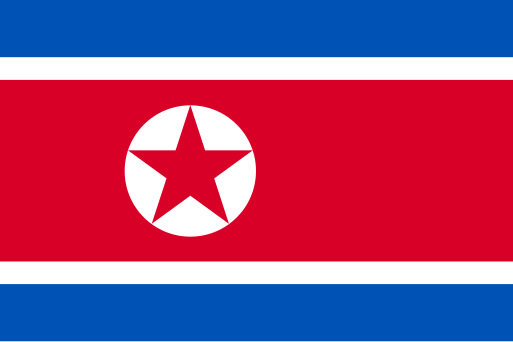 North Korea
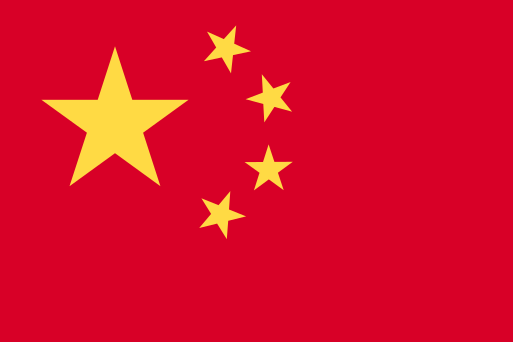 China
China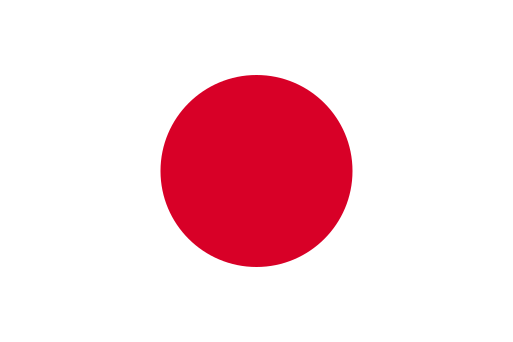 Japan
Japan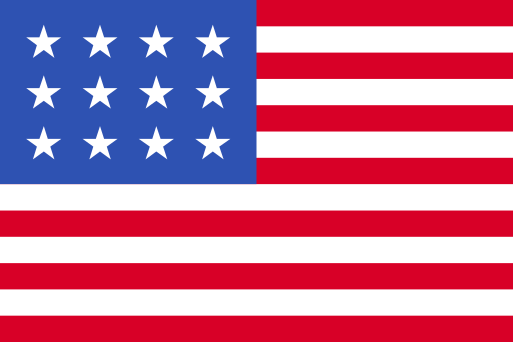 United States
Schematic selection of key areas where the language is used. Language use does not always follow national borders; the map is not a comprehensive population statistic.
The language alone is not decisive. ABBA-Sprachendienste also considers the document type, recipient, subject area, certification requirements and requested language direction.
Request a document reviewKorean belongs to the Koreanic language family. Chinese characters were the principal writing system for many centuries. In the 15th century, the distinct Hangeul alphabet was created under King Sejong.
Hangeul arranges letters into syllable blocks and is the principal script used today. North and South Korea differ to some extent in vocabulary, spelling and official terminology.
Hangeul may look like a character-based script, but it consists of letters arranged into syllable blocks.
Korean names may be written using different romanisation systems. The officially used form takes precedence.
North and South Korean documents differ in their terminology, forms and institutions.
The transliteration is intended only as an initial guide. Pronunciation and regional forms may vary.
| Original | Transliteration | Meaning |
|---|---|---|
| 안녕하세요 | annyeonghaseyo | Good day |
| 감사합니다 | gamsahamnida | Thank you |
| 부탁드립니다 | butakdeurimnida | Please |
Speaker numbers are rounded estimates and may vary depending on the definition, survey year and whether second-language speakers are included.
Wikipedia · language-specific overview
Library of Congress / ISO 639-2 Registration Authority · Language codes and standardised language names
Unicode Common Locale Data Repository · Language, script and territory names and variants
Max Planck Institute for Evolutionary Anthropology · Language families, classification and linguistic literature
Editorial sources current as at 14 July 2026. The information will undergo a specialist review before the production launch.
Korean FAQ
Both directions can be requested. Binding confirmation is provided after the document type, subject area, certification requirements, appointment and intended use have been assessed.
Birth and family-register documents, diplomas and transcripts, corporate and commercial documents, and certificates are typical examples. Other types of document can also be assessed from a clear photograph or PDF.
We check the language direction, document type, script—Hangeul, with Chinese characters in some older contexts—names, stamps, subject area, intended use and whether certification may be required.
The receiving authority, court, notary or other requesting body decides this. Tell ABBA-Sprachendienste where the document will be submitted so that the requirements can be assessed appropriately.
Yes. A complete, sharp and clearly legible photo or PDF is usually sufficient for an initial quotation review. Depending on the assignment, the original may also be required later.
Send a clear photo or PDF. ABBA-Sprachendienste will personally assess the language direction, document, intended use and certification requirements.
